As geopolitical tensions rapidly rise and public and media attention is increasingly distracted, greater focus is required on drivers, scalers and accelerants of critical challenges to national security. But we cannot decouple the rise in geopolitical tensions – and their implications for defence priorities, societal resilience and spending – from the very real ‘whole of society’ and holistic security implications of the cascading effects of climate breakdown and biodiversity loss.

Many of the key drivers of instability and risk are environmental, and they are not ‘coming down the road’ but already happening. National security is more than ‘hard’ defence, it is food and energy security, migration flows, public health (physical and mental), nature, water and resource access, economic realities and cost of living, opportunities for young people, and more. Each are increasingly impacted by the interconnected climate and nature crisis. These highly politicised and emotive issues are set within a context of mis/disinformation and limited knowledge or understanding of the science among both the public and political decision-makers.

This six-month project, convened by the Agile Initiative and the Oxford Martin School, brings together Oxford University experts with politicians, policy makers and professionals in the climate, nature and national security space and beyond. It explores urgent evidence needs and use in response to the climate and biosphere emergency and its implications for UK national security.

Why this, why now?

With the publication of the UK’s national security assessment on global biodiversity loss, ecosystem collapse and national security, NATO’s 2026 report on the effects of climate change on security, and momentum from the National Emergency Briefing on climate and nature, there is growing energy and attention on this complex area.

Policy makers and research funders are looking to the research community to provide evidence rapidly to answer increasingly complex questions at the intersection of climate, nature and national security. This is reflected in UK government priorities as well as planned spending on research and development.

This high-speed and ambitious project is truly requiring Agile to be agile, working iteratively to rapidly develop a multi-disciplinary, multi-stakeholder dialogue, bringing people together and mobilising them to work collaboratively on a forward-facing research agenda.

This project aims to:

  • Unpack understandings of climate, environment and biodiversity in relation to national security among decision-makers and researchers, creating a baseline of understanding that enables effective communication and collaboration in this field.
  • Work with policy and academic specialists to explore ‘demand signals’, knowledge gaps and opportunities at the intersection of climate, environment, and national security, especially around priority policy areas in the UK but recognising the global interdependence in all these areas.
  • Identify a forward-looking research agenda that the interdisciplinary research community can act on with partners to respond to emerging risks at the intersection of the climate-biosphere crisis and UK national security. 
The challenge

Delivering sustainability commitments – like the Sustainable Development Goals (SDGs), Paris Agreement, and the Kunming-Montreal Global Biodiversity Framework – requires navigating complex, intersecting crisis such as biodiversity loss, climate change, and widening inequalities. It is increasingly recognised that these challenges demand transformative change: deep shifts in the values, cultures, institutions, and power relations shaping how society manages the environment and the economy.

Wales possesses world-leading legislative foundations for a wellbeing economy, including the Well-being of Future Generations Act (Wales) and the Environment (Wales) Act. Place-based working bridges these high-level ambitions and everyday delivery by enabling cross-sectoral decision-making grounded in local knowledge. In Wales, this is embodied in statutory mechanisms like Area Statements (mandated regional environmental plans) and Public Service Boards.

However, at the outset of this Sprint, evidence on how these approaches functioned remained uncertain. Inside Natural Resources Wales (NRW) – the body responsible for Area Statements – leadership transitions and resource pressures had created ambiguity about the future of the policy. Divergent views on the purpose of Area Statements posed a real risk that place-based working could drift into a hiatus ahead of planned policy revisions and the May 2026 Senedd elections, leaving brilliant on-the-ground innovation increasingly disconnected and unsupported.

The solutions

Operating through an embedded, co-created research model, the Sprint delivered actionable insights to help NRW and the Welsh Government translate legislative ambition into local delivery:

  • National policy suggestions: An evidence-based report and briefing calling on decision-makers to explicitly support and scale existing locally led experimentation.
  • Evidence challenging failure narratives: Using a hopeful, future-oriented framing, the research challenged the assumption that Area Statements had failed, providing empirical support for a strengthened delivery model using existing statutory architecture.
  • Strategic policy integration: Actionable insights directly shaped the State of Natural Resources Report (SoNaRR) ‘Bridges to the Future’ chapter.
  • Cross-border knowledge sharing: Survey and interview data served as a boundary object to facilitate knowledge exchange with the Scottish Government and Whitehall.
  • Highlighting existing successes (case studies): Site visits and case studies – from urban catchments on the River Taff to intergenerational farming at Cwmsefin Farm and Community Wealth Building at Blaenau Ffestiniog – demonstrated that integrated governance is already unfolding and requires long-term public support.

These solutions translated competing perspectives into clear evidence on policy options. The Sprint successfully unblocked stalled discussions, prevented a policy hiatus, and proved that complex governance can be reimagined when researchers and policymakers learn together.

The pathway

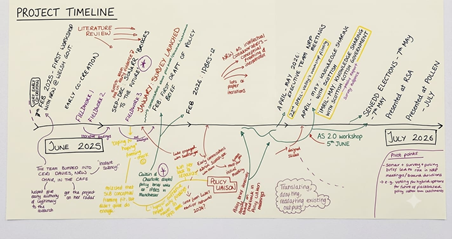
The Sprint utilised an adaptive approach, starting with a co-creation workshop alongside NRW in February 2025. Working deliberately within the ambiguity of organisational change, the team deployed ‘mini Sprints’ (lasting approx. 2-4 weeks) to test and learn rapidly.

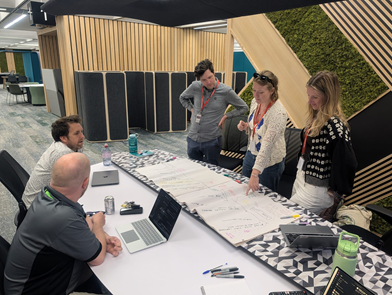
Photos: the Sprint team worked collaboratively with NRW to develop a timeline of the project’s pathway and outputs, incorporating both tangible milestones and the relational networks that continuously underpinned and shaped them, during an end-of-project workshop at the Welsh Government.

A dedicated Policy Liaison bridged the academic team and NRW colleagues through weekly engagement. This replaced static final reports with a ‘living’ evidence base, creating continuous formal and informal feedback loops between empirical research, strategy, and operations.

Through embedded observation, a survey, and rapid knowledge exchange, researchers and policymakers jointly interpreted findings. This allowed the research to continuously reshape policy discussions – and for policy shifts to immediately inform the research direction. As policy windows opened and closed, the team rapidly translated evidence for diverse audiences, including senior leaders and external partners, helping disconnected teams agree on future options. Crucially, NRW acted as true intellectual collaborators throughout the process.

What happened next?

The Sprint’s findings successfully underpinned the next five years of environmental governance discussions. Most notably, this evidence informed an overwhelming 30 out of 31 Executive Team vote to pursue a hybrid delivery model for ‘Area Statements 2.0’.

This action prevented a potential year-long policy hiatus and rebuilt organisational capacity. NRW’s Integrated Evidence Manager confirmed the research ‘helped us reimagine what Area Statements could be used for’ and will underpin governance for years to come.

Beyond formal reports, the Sprint achieved profound relational and cultural impacts. It surfaced ‘quiet wins’ in the informal spaces of organisational learning by reconnecting practitioners across silos. It shifted stakeholders from feeling isolated to forming a genuine coalition, as one NRW partner noted:

‘What’s been most interesting for me is how much this project has helped people feel like they’re part of something again. There’s been a real shift from people firefighting on their own or feeling quite isolated, towards a sense that there’s still a genuine coalition of people who care about place-based working and are trying to move it forwards.’

To share these learnings, the team is finalising a suite of outputs, including a July 2026 research report and paper pre-print. Additionally, the team are working with Kinward to produce a documentary film celebrating the partnerships already driving change across Wales. The film frames local efforts as living micro-experiments in learning and innovation, demonstrating how locally led actions generate valuable lessons about collaboration and environmental change. The film emphasises that by recognising and supporting these bottom-up initiatives, the government can scale successful approaches to build a resilient future for people and nature.

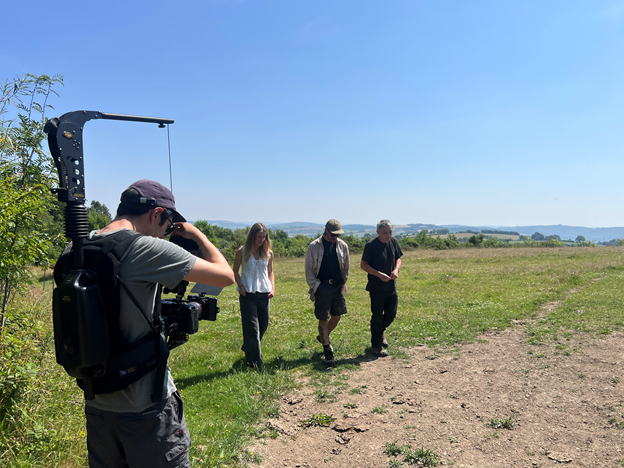
Photo: The Sprint team filming in Powys, Wales, with Ross Harrison and Grace Alexander from Kinward.