How can curriculum designers provide better Net Zero education for the next generation?
This Sprint ran from July 2025 to July 2026.
Sustainable development goals
More Sprints
- Science-to-policy projects (2026)
- Environment and National Security: Exploring Policy ‘Demand Signals’ and the Science Response
- How can action on deforestation strengthen the UK’s food system security and resilience?

The challenge
Net zero has become one of the defining frameworks for responding to climate change, yet most young people in England leave school without having had the opportunity to learn about it in a meaningful way. At the same time, England entered a rare period of curriculum reform, creating a unique opportunity to consider how climate and sustainability education could better prepare young people for the challenges and opportunities of a changing world.
This Sprint set out to understand how net zero is currently taught in schools and to identify how curriculum designers, policymakers and educators can better support high-quality net zero education. Working with teachers, young people, climate experts and policymakers, the team aimed to translate cutting-edge climate research into practical guidance that could help embed net zero across the curriculum and ensure all young people have access to relevant, equitable and future-focused learning.
The solutions
The Sprint found that net zero is rarely taught explicitly in English secondary schools, despite its growing importance in policy and public life. While climate change features in some subjects, particularly Geography, many teachers reported limited confidence in defining or teaching net zero and identified a lack of accessible resources and professional development opportunities.
At the same time, the research revealed strong enthusiasm among teachers and young people to engage with the topic. Teachers expressed a desire for practical, solutions-focused approaches, while students demonstrated a strong appetite to participate in discussions about climate action and their future. The findings highlighted the need for interdisciplinary teaching that connects environmental, social, economic and technological dimensions of net zero, alongside greater support for educators.
To address these challenges, the Sprint co-created the Net Zero Education Framework, providing guidance for curriculum designers and educators seeking to integrate net zero across subjects and educational settings. The project also produced resources for teachers, policymakers and young people.
The pathway
The Sprint combined research, co-creation and stakeholder engagement throughout its delivery. Researchers worked with teachers across 18 schools, conducting interviews, classroom observations and analysis of teaching practice to understand how net zero is currently represented in education. This evidence was complemented by a scoping review, expert workshops and ongoing engagement with policymakers.
Central to the project was a collaborative approach involving teachers, young people and experts from across the University of Oxford. A Youth Advisory Board brought together students from across the country to help shape outputs, develop resources and contribute their perspectives on net zero education. The team also worked closely with the Department for Education, Oxford Net Zero, educational partners and a multidisciplinary expert group to ensure that findings were both academically robust and relevant to policy and practice.
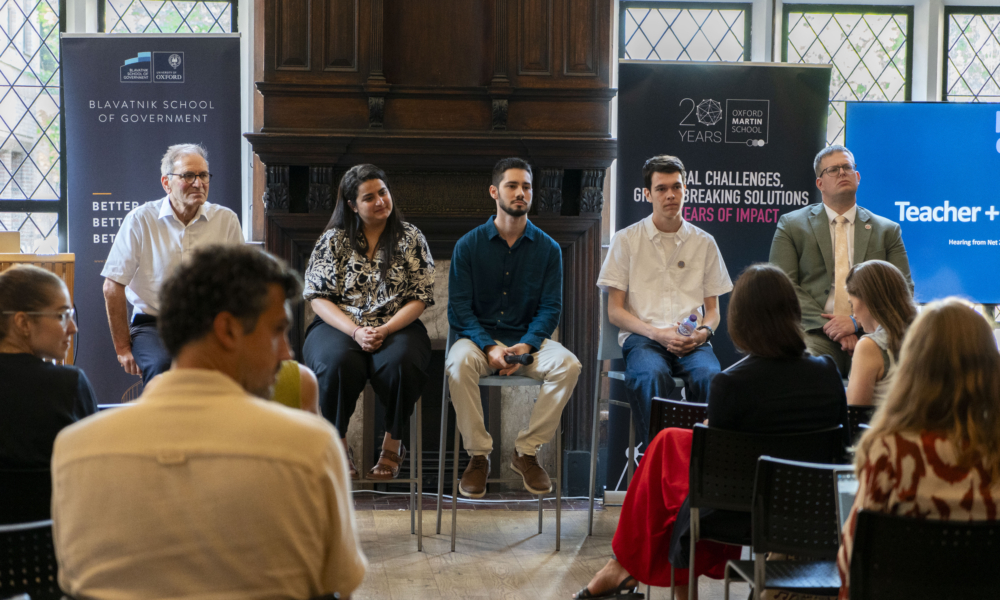
The project culminated in a teacher Continuing Professional Development Day featuring leading experts from across Oxford, creating opportunities for educators to explore net zero through multiple disciplinary lenses and translate research into classroom practice.
What happened next?
The Sprint has already begun to influence teaching practice and curriculum development. Teachers who participated in the project reported increased confidence in discussing net zero and identified new opportunities to embed the concept within their teaching. In one example, the project contributed to the development of a dedicated net zero geography unit intended for use across a multi-academy trust of ten schools.
The project also strengthened engagement between researchers, educators, young people and policymakers. Through ongoing links with the Department for Education, contributions to curriculum discussions and the publication of the Oxford Net Zero Education Framework, the Sprint has provided practical resources to support future curriculum development and implementation.
Building on the Sprint, the team is continuing to develop educational resources, support its teacher and youth networks, and pursue further funding to expand the work. Academic publications, policy engagement and partnerships with organisations including Oxford Net Zero and the Zero Institute will take the research forward, helping to foster a growing community of practice around net zero education.