


Children, Food and Fireproofing: Agile at London Climate Action Week
Recent News
- Explore our short documentary series: The Power of Place
- The power of place: Learning from community-led innovations in Wales
- It takes a community: reflections from the Agile Symposium 2026
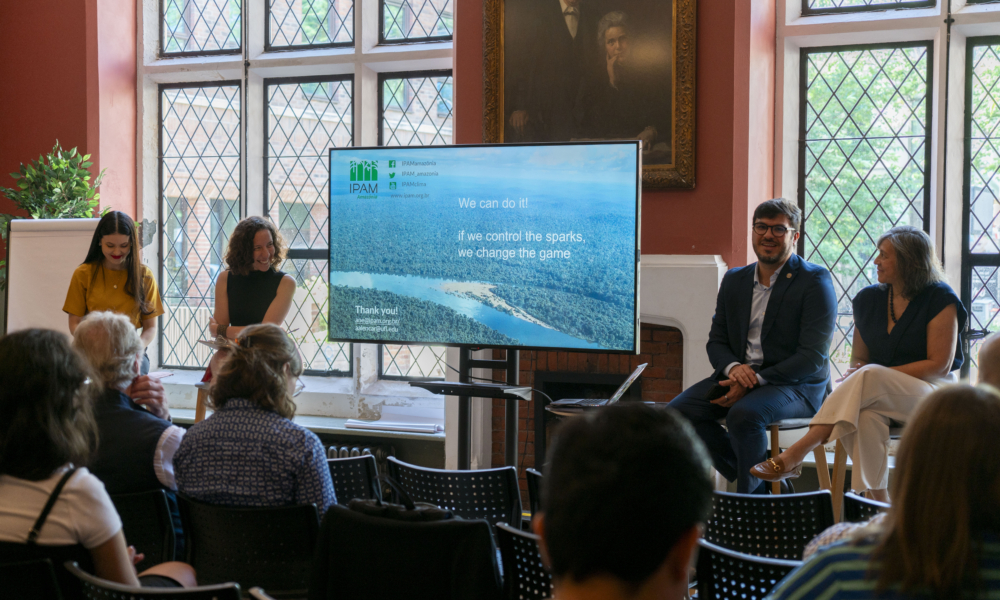
Agile showcased some fantastic research at this year’s London Climate Action Week. We presented as part of the “Oxford Venue” which hosted a range of talks and workshops from the University of Oxford. Although taking place on the hottest days of the year, on June 23rd & 24th the venue had two days of jam-packed events and saw hundreds of visitors coming through the door! Thanks to the Oxford Martin School and the Smith School of Enterprise and the Environment for all their support.
Read on to see what was presented, and how you can find out more about these important projects.
Fireproofing the Amazon
Climate agencies across the world have predicted that later this year an El Niño will start. In the Amazon, El Niño events are linked to increased temperatures and reduced rainfall, turning the rainforest into a flammable ecosystem.
In this panel, researcher Erika Berenguer (ECI) hosted a session to discuss recent patterns of Amazonian forests fires, their environmental and social impacts, as well as solutions to the firestorm to come in 2026. Speakers included: Renata Nobre, Leonardo Carvalho, Mailsa Assis da Silva, Ane Alencar, and Erika Berenguer.
Next steps: Get in touch with Erika Berenguer to discuss her research on fireproofing the amazon.
Nature on our Plates
The more ‘regenerative’ our agriculture, the more what we produce, process, and consume must shift alongside how we produce it. Using pulses as case study and guide, we ask who needs to be ready to accommodate that change. The session explored questions of credit, consumption shifts, and whether pulses suggest a different regenerative path.
At this interactive session, University of Oxford research groups looked to the audience to connect insights from two projects, Reckoning with Regeneration and the UK Pulses Roadmap. Through short provocations and facilitated discussion, participants reflected on how regenerative ambitions translate into practice across farming, supply chains and diets. Speakers included: Richard Kipling, Jing Zhang, Tara Garnett and Monika Zurek.
Next steps: Get in touch with Ruth Mattock to learn more about regenerating agriculture, and Jing Zhang to learn more about the UK pulses roadmap.
Children and Climate Change
There are currently one billion school aged children around the world, and an overwhelming number of them live in countries grappling with the consequences of a warming planet. For this generation, the climate crisis is a present-day emergency resulting in impairments that will last their entire lives. Climate change is already impacting their health, education, and overall wellbeing, and in turn effecting the prosperity of entire communities and nations. And a lack of education about the solution to global warming, reaching net zero emissions, is a further injustice to current youth fighting for change.
Today’s children are tasked with the monumental challenge of understanding, adapting, and responding to these challenges. This session brought together two research projects based at the University of Oxford which are building the scaffolding to allow this to happen. Speakers included: Alan Stein, Leonardo Ferreira, Ashima Gulati, Gordon Carrothers and Leo Hawkins.
Read more about the event on the Blavatnik School of Government news page.
Next steps: Get in touch with Sean Marshall to learn more about the children and climate initiative, and Steven Puttick to learn more about net zero education.
COMING UP NEXT
Two of our events fell casualty to the heat wave, with teams making the hard decision to postpone. Those teams will be reorganising events to take place online:
Environment and Security
This high-speed project is co-created with policy makers from across government to explore the urgent evidence needs and uses in response to the cascading climate and biosphere emergency and its implications for national security in and beyond the UK.
We are excited to be showcasing the work so far in an event at the House of Lords on 13th July. In the spirit of Agile co-creation and collaboration, this will be an interactive event with policy makers, parliamentarians and members of the academic team.
We will also hold a webinar which will include a series of flash talks from our researchers followed by a chaired panel and Q&A including project collaborators from the Ministry of Defence and the Department for the Environment, Food and Rural Affairs.
Register for the webinar: Environment and National Security – Fill in form
Next steps: Get in touch with Tim Clack to learn more about the environment and national security project.
Green Procurement
This science-to-policy research project have produced a white paper, “Procurement for the Planet: Policy Approaches to Greening Public Spending”.
Governments spend huge amount of money in the private market—over $9.5 trillion in annual spending, of roughly 13-20% of global GDP. This white paper considers how governments are applying that spending in innovative ways that further their climate and environmental objectives whilst shaping markets. Drawing on over 60 interviews with procurement practitioners in over 11 jurisdictions, and examining key areas of spending—namely construction and food—the paper looks to real world examples of governments greening what they buy, who they buy from, and how they buy. The paper distils lessons that policymakers can use to deepen the sustainable transformation of public procurement.
The team will be holding an online launch of the paper in September, please get in touch if you’d be interested in attending.
Next steps: Get in touch with Emma Lecavalier to find out more